
Types of PCR: Complete Guide to Polymerase Chain Reaction Variants
Introduction to PCR
Polymerase Chain Reaction (PCR) is one of the most important techniques in molecular biology, enabling scientists to amplify specific DNA sequences. Since its invention by Kary Mullis in 1983, PCR has revolutionized diagnostics, genetics, forensic science, and biotechnology.
Today, several Types of PCR have been developed to address different research needs such as gene expression analysis, mutation detection, pathogen identification, and DNA quantification.
Understanding the different types of PCR helps researchers select the most appropriate method for their experiment.
Types of PCR
1. Conventional PCR
Conventional PCR is the standard amplification method used to generate multiple copies of a target DNA fragment.
Principle
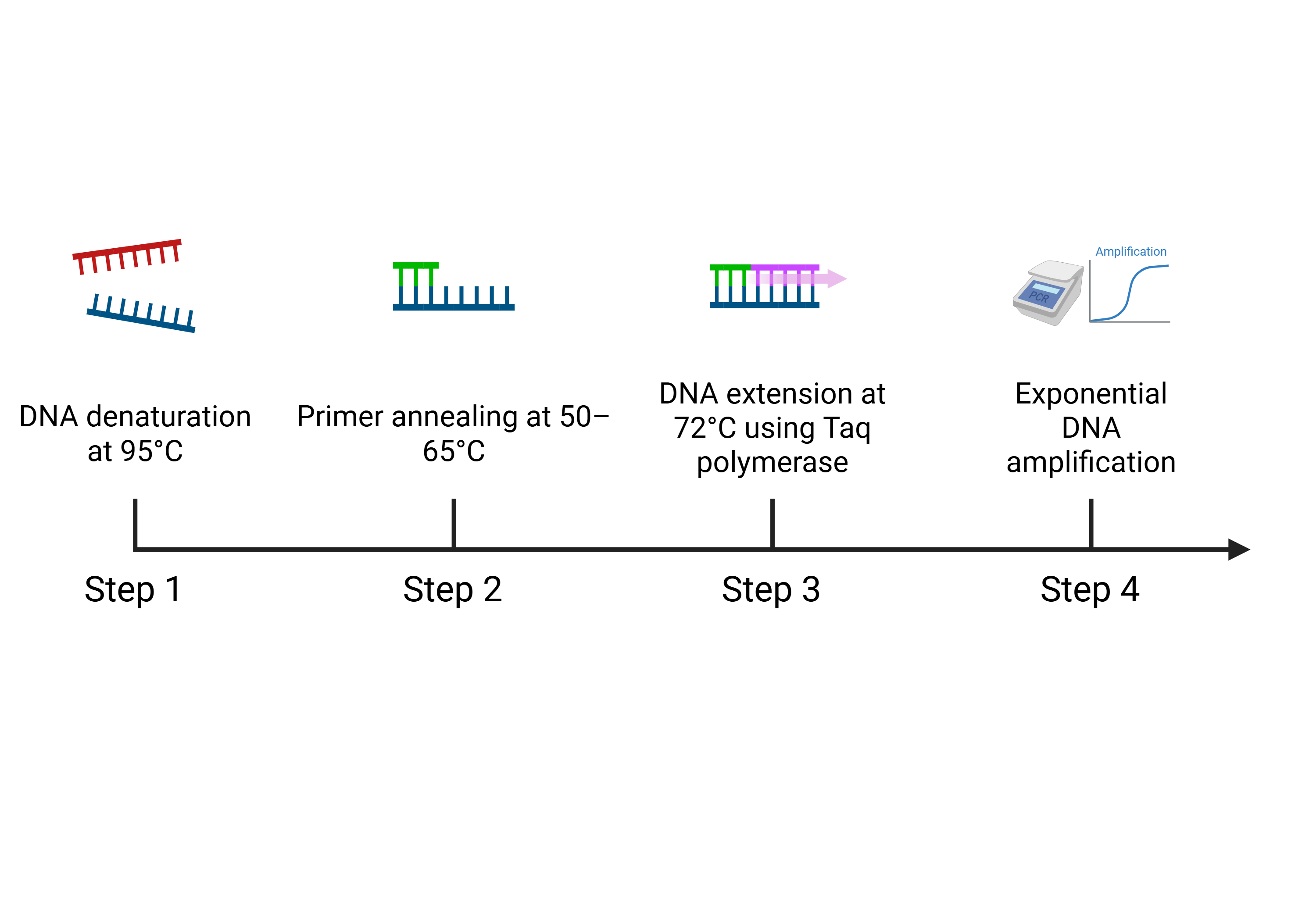
DNA amplification occurs through repeated cycles:
-
Denaturation (DNA strands separate)
-
Annealing (primers bind to target sequence)
-
Extension (DNA polymerase synthesizes new DNA)
Applications
DNA cloning
Genetic mutation detection
Pathogen identification
2. Real-Time PCR (qPCR)
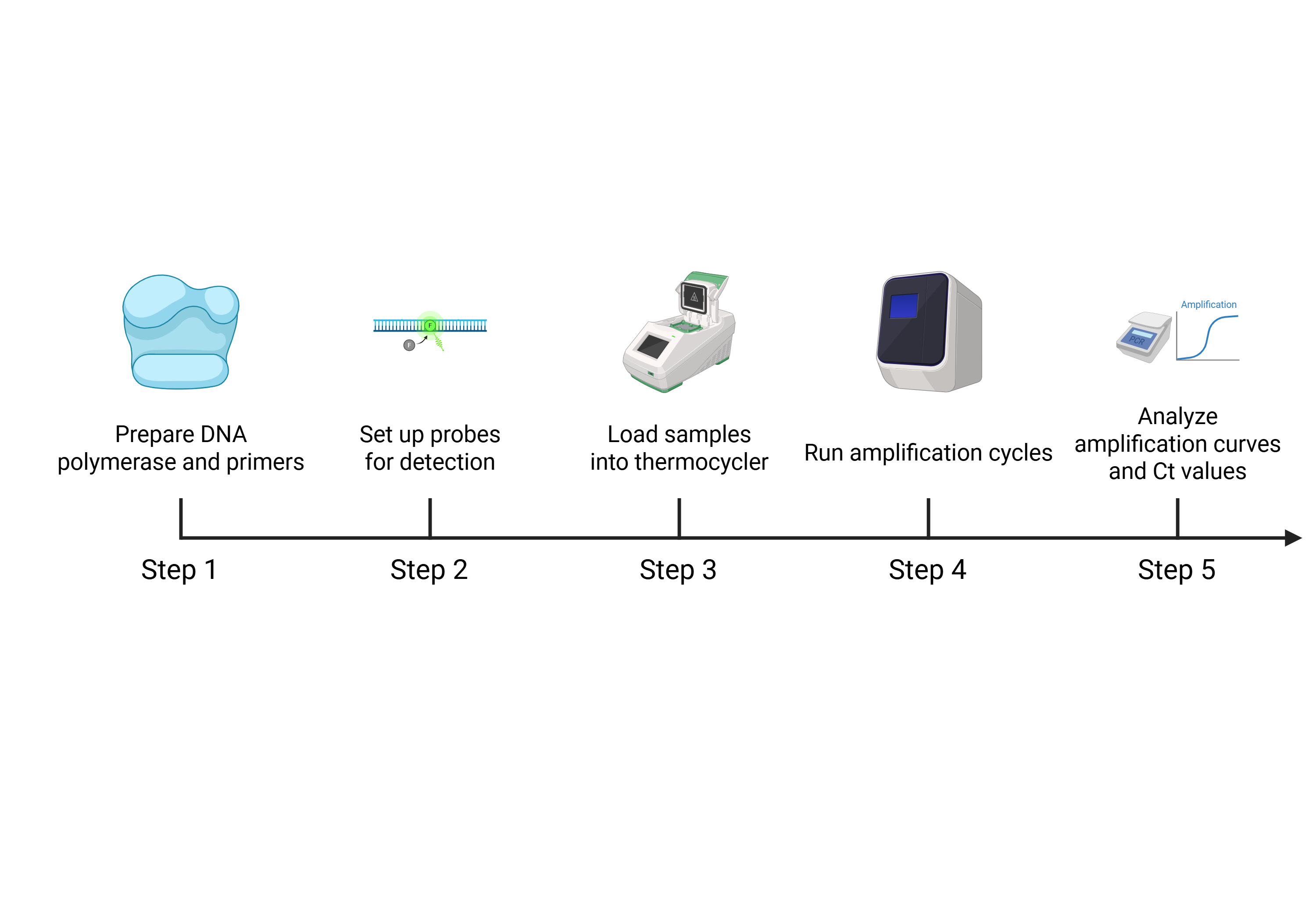
Quantitative PCR (qPCR) measures DNA amplification in real time using fluorescent dyes or probes.
Key Features
Quantifies DNA during amplification
Uses fluorescent markers like SYBR Green
Highly sensitive and accurate
Applications
Gene expression studies
Viral load detection
Diagnostic testing
3. Reverse Transcription PCR (RT-PCR)
RT-PCR is used to amplify RNA molecules by first converting RNA into complementary DNA (cDNA).
Process
-
Reverse transcription (RNA → cDNA)
-
PCR amplification of cDNA
Applications
Viral RNA detection
Gene expression analysis
Transcriptomics
. Multiplex PCR
Multiplex PCR allows simultaneous amplification of multiple DNA targets in one reaction using multiple primer sets.
Advantages
Saves time and reagents
Enables simultaneous pathogen detection
Efficient for genetic screening
Example Applications
Respiratory pathogen panels
Forensic DNA analysis
Mutation screening
5. Nested PCR
Nested PCR improves specificity and sensitivity by using two sets of primers.
Steps
-
First PCR amplifies a large DNA region
-
Second PCR amplifies a smaller internal fragment
Applications
Detection of low abundance DNA
Pathogen diagnostics
Rare mutation detection
6. Digital PCR (dPCR)
Digital PCR is an advanced method used for absolute DNA quantification.
Principle
The sample is partitioned into thousands of micro-reactions, each containing 0 or 1 DNA molecule.
Benefits
Ultra-high sensitivity
Absolute quantification
Mutation detection
Applications
Cancer liquid biopsy
Rare mutation detection
Copy number variation analysis
7. Hot Start PCR
Hot start PCR reduces non-specific amplification by keeping the DNA polymerase inactive until the initial heating step.
Benefits
Higher specificity
Reduced primer-dimer formation
Improved amplification efficiency
8. Touchdown PCR
Touchdown PCR gradually reduces the annealing temperature during cycling.
Advantages
Improves specificity
Minimizes non-specific amplification
9. Colony PCR
Colony PCR allows direct amplification from bacterial colonies without DNA extraction.
Uses
Screening recombinant clones
Verifying plasmid insertion
10. Long-Range PCR
Long-range PCR amplifies very large DNA fragments (up to 30 kb or more).
Applications
Genome sequencing
Structural DNA studies
Comparison of Major Types of PCR
| PCR Type | Detects | Quantification | Main Use |
|---|---|---|---|
| Conventional PCR | DNA | No | Cloning, detection |
| qPCR | DNA | Yes | Diagnostics |
| RT-PCR | RNA | Yes (with qPCR) | Gene expression |
| Multiplex PCR | Multiple DNA | No | Pathogen panels |
| Digital PCR | DNA | Absolute | Mutation detection |
Future of PCR Technologies
New developments in microfluidics, AI-assisted diagnostics, and ultra-fast thermocyclers are expanding PCR capabilities.
Emerging technologies combine PCR with sequencing platforms such as Next-Generation Sequencing, enabling rapid genomic analysis in research and clinical diagnostics.
Conclusion
Understanding the different Types of PCR is essential for selecting the right method in molecular biology experiments. From conventional PCR to advanced digital PCR, each technique offers unique advantages for DNA amplification, quantification, and molecular diagnostics.
As biotechnology evolves, PCR will remain a cornerstone of genetic research, medical diagnostics, and personalized medicine.
Recent Posts
-
Herpes Simplex Virus 2 (HSV-2)
Herpes Simplex Virus 2 (HSV-2): A Comprehensive Guide Introduction Herpes Simplex Virus 2 (HSV-2) is …2nd Apr 2026 -
Homologous Chromosomes
Homologous Chromosomes: Key Traits & Biological Significance Introduction Homologous chromosomes are …2nd Apr 2026 -
CUT&Tag vs CUT&RUN Which Epigenomics Method Should You Choose?
CUT&Tag vs CUT&RUN: Which Epigenomics Method Should You Choose? The field of epigenetics has undergo …17th Mar 2026